
We’re excited to welcome all First Foundation Bank customers to Sunflower Bank’s accounts and services. Please access online banking portals through the Login box. For helpful information, please visit SunflowerBank.com/MergerUpdates.
A Quarter Defined by Yields: Higher Rates, Elevated Uncertainty, and Resilient Markets
10/22/26
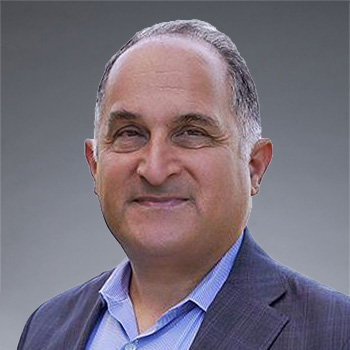
Prepared by John Hakopian, President, FirstSun Advisors
Market Overview
The biggest news in the quarter was that the Federal Reserve delivered its first-rate hike in more than three years – long term Treasury yields pushed to levels not seen in two decades and oil rose by more than a third as the war with Iran reignited. The S & P 500 managed to gain 2.3% in the third quarter, closing the quarter near record highs driven by strong corporate earnings. But the real story came in the bond market with the rate hike.
The September 16th rate to 3.75-4% was unanimous and the Fed implied at least one more increase this year. The 10-year Treasury yield closed the quarter at 5.29%, near its highest since 2007. The 30-year reached 5.63%, its highest since 2002. Chair Warsh’s message was clear – inflation is too high and has been for too long.
The rise in long end of the Treasury curve is not solely an inflation story. Inflation data cooled into quarter-end, partially helped by a methodology overhaul while at the same time economic growth was revised up. Inflation is certainly part of the story, but we think yields are also rising for another set of reasons: a resilient CAPEX driven economy, a historic amount of supply of bonds from the Treasury and the hyperscalers, and a Fed that removed the safety net.
The war with Iran continues to grind on, with Brent crude rising roughly 35% for the quarter and briefly topping $108 in September. The artificial intelligence trade completed a round trip – unraveling in July, roaring back on NVIDIA’s results in August – and earnings expectations for the third quarter stand near 29% growth.
The third quarter’s story was one of divergence. The S & P 500 returned 2.3% in the quarter and is up 12.7% for the year. The bond market, however, took over the narrative for the quarter. The Federal Reserve raised interest rates for the first time in more than three years, long-term Treasury yields pushed to levels last seen two decades ago, and oil rose by more than a third as the war with Iran continued. Most bond indices were negative for the quarter.
The Nasdaq Composite gained 2.6% and set a record in late September. The Dow Jones Industrial Average, by contrast, fell 2.3%, and September was particularly unkind to the blue-chip index, which dropped 4.1% in the month, It was particularly difficult quarter for small-cap stocks as the Russell 2000 Index fell -7.2%. International Equity markets fared worse in large part thanks to a stronger dollar during the quarter from rising rates. European equities (MSCI Europe TR) fell -1.6% and emerging market stocks (MSCI Emerging markets TR) dropped -0.4%. Japanese stocks (MSCI Japan TR) were top performing major equity market with a return of nearly 6.53% in USD terms in the quarter.
Sector returns paint a similar story. As yields surged in September, the financial sector fell more than 7%, its worst month since early 2023, while energy rode the oil shock higher and technology benefited from AI optimism. The market began the year broadening out but spent much of third quarter re-concentrating. The same is true for many other asset classes relative to the S & P 500. The S & P 500 was flat during September versus the equally weighted version fell -4.8% - and the former market cap weighted Index is now ahead of its equal-weighted counterpart for the year. The dispersion between winners and losers widened considerably. Just two of the eleven GICS sectors have year-to-date returns higher than the S & P 500’s 12.7% return.
The Economy
The U.S. economy Continues to grow and outpace expectations. The labor market stumbled somewhat over the summer, only a combined 52,000 jobs over June and July. August saw a clear improvement with payrolls rebounding by 162,000 against expectations of roughly 55,000, while the unemployment rate held at 4.1%. It’s a whipsaw kind of year for labor markets, but looking through the noise the labor market remains fine and in better shape than how it entered the year. Economic growth was revised higher for the second quarter, moving up to 2.2% from 1.5%. It was also higher for the first quarter to 2.5% from 2.1%. The economy continues to grow at a healthy clip, powered in no small part by the largest capital-spending boom in modern history. That resilience has been good for earnings, but more complicated for the direction of interest rates.
Interest Rates
On September 16th, the Federal Open Market Committee raised the federal funds rate by a quarter point to a range of 3.75%-4%. It was the first increase in more than three years, and it partially reverses the easing cycle of late 2025. Contrary to many expectations prior to his appointment, Fed Chair Kevin Warsh has taken a hawkish stance on inflation and has departed from the Trump administration desire to lower rates. Hawkish dots appeared in June then there was a split 9-3 hold in July with three dissents in favor of a hike. Then in his August Jackson Hole speech, Warsh gave a blunt declaration on inflation that the Fed had work to do. He followed that up with the first hike in three years.
The FOMC projections further drove home the message. The median projections for the funds rate at year-end rose to 4.1%, implying at least one more hike at one of the two remaining meetings of the year. The 2027 median estimate sits at the same level, showing an expectation that rates will go up and stay higher, not a quick round trip. September’s projections showed that committee members see risks skewed to the upside for inflation with the Iran war further escalating inflation. They are less concerned about a slowdown in the economy.
The Fed delivered its most hawkish act in years into inflation data that promptly moderated as a result of methodology changes. September’s final week brought the Bureau of Economic Analysis’s annual revisions, which rewrote how several categories of services inflation are measured and applying them retroactively across the last five years. July’s core PCE reading was revised to 3% from 3.3%, and August held at 3% compared to expectations above 3.3%. August headline inflation came in at 3.4%. But even the friendlier methodology leaves core inflation a full point above the 2% target, with the services categories the Fed watches most closely still running near 4%. September’s inflation data came in higher as a result of a surge in oil prices due to the Iran war. The Fed hiked into an inflation picture that is better than feared and expects at least one more hike this year with the majority believing it happens in December after the midterms.
The Bond Market
The 10-year Treasury yield ended the quarter at 5.29%, within sight of its 2007 highs, after rising more than half a percentage point in September alone. The 30-year closed at 5.63%, a level last seen in 2002 (see chart).
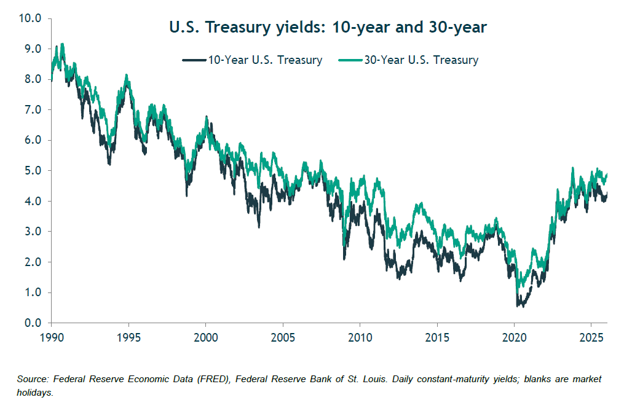
The move higher in rates is more than just an inflation story. The strength of the CAPEX-driven economy is real, and it can bear a higher cost of capital. The economy is running hotter than expected. The upward revisions to growth with a capital-spending boom without much precedent. The major technology platforms are deploying roughly 600 billion CAPEX this year, with most of it in AI infrastructure. The economy in nominal terms has not grown at this pace in a long time.
Also adding to the upward pressure in rates is the supply of bonds. The federal deficit for fiscal year 2026 is running at around 2 trillion. There is no desire to curb spending in Washington. To finance these deficits, the Treasury’s issuance calendar remains fully booked well into the future. The other leg of the stool is growing corporate debt issuance. The same AI Buildout growing the economy is being financed, in the bond market. The hyperscalers and their ecosystem has issued an enormous amount of debt in the AI race. To put that in perspective, AI debt issuance has ramped up from 5% of net Treasury issuance a year ago to over 30% this year (See Chart below).
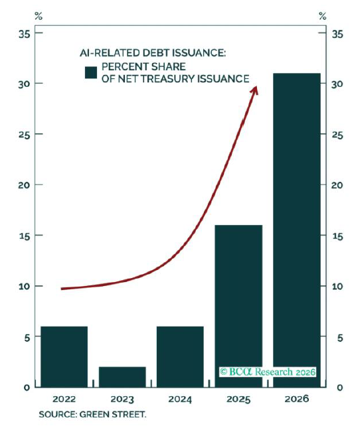
Every dollar of investor demand absorbed by the hyperscaler debt is money not bidding for Treasuries’ – which should then force the yield need to clear Treasuries’ higher.
As a result of September’s rate rises, bond portfolios can now easily be constructed to have yields in the mid to upper single digits –attractive all-in yields levels to consider when compared even equity markets. We are extending duration in Municipal and corporate bonds while keeping high credit quality.
Equity Markets
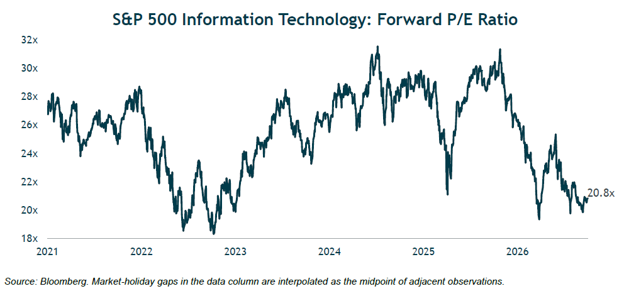
Where does this leave the equity market? Current earnings are real and the spending on AI infrastructure is real. The financing of the spending has become a market force. Third quarter earnings for the S & P 500 are expected to grow roughly 29% year over year, which would be a third consecutive quarter above 25%, with the growth led by technology. Tech earnings are expected to come at 65% YoY growth for the third quarter (Factset). As a result, the forward multiple of the sector sits at roughly 20 times which is slightly below its five-year average (chart).
Returns were again solid outside the United State for the year. Emerging-market equities were the standout, leading foreign markets. We remain globally diversified and slightly overweight in the US Large Cap. Markets move rapidly and we want to remain positioned for either a rising or a declining interest rate environment. If the war ends, interest rates will trend downward again but if the war persists, we might remain higher for longer.
Alternatives
Alternatives provide powerful long-term portfolio benefits and non-correlated returns to traditional stock and bond holdings and can potentially improve risk-adjusted returns of balanced portfolios. Given the current volatility in public equity and bond markets, alternative investments have delivered good relative returns with low volatility just as we would have expected.
We favor private real estate investment allocations to multi-family, industrial, and self-storage, and selected grocery-anchored centers. We expect equity like long-term returns from these investments. We feel that our real estate investments mayalso benefit significantly if the Fed cuts interest rates. We also favor private equity but have sold most of our remaining private credit investments as they no longer offer good risk/reward characteristics. We believe alternatives tend to follow public markets and offer meaningful upside. We will continue to add alternatives to our diversified balanced portfolios.
Conclusion
The fourth quarter is here with a full calendar. The midterm elections come November 3rd. The Federal Reserve meets just a week before midterms (October 27th-28th) and again in early December. Third quarter earnings season begins mid-October with 29% growth expectations. The continued resolution that passed without much fanfare in early September averted a government shutdown but only funds the government through December 11th. Needless to say – we will see some volatility in the 4th quarter.
The markets and economy have remained resilient so far in 2026 despite numerous things to worry about. Markets sit near record highs, after having recovered losses in the first quarter. They have done so while inflation reaches a three-year high, the Federal Reserve pivoted from rate cuts to rate hikes, and a war shut off the key transportation route for many energy commodities. The markets have moved through all of it.
Our base case remains positive, with real GDP growth, supportive consumer spending, and ongoing investment in infrastructure, energy and Artificial Intelligence all expected to enhance productivity.
Despite volatility, equity market fundamentals remain strong. Market leadership has narrowed again to mega-cap technology stocks, but we expect that to reverse if the war ends or rate hikes reverse. Most importantly, corporate earnings expectations continue to expand in 2026 to over 20% per annum.
Credit fundamentals remain sound. Attractive starting yields have resulted in fixed income returns increasingly driven by income rather than prices appreciation.
This is a moment to stay disciplined. We remain vigilant to the changing geopolitical landscape. We continue to maintain diversified portfolios, balancing risk and opportunities, and positioning to benefit from long-term secular trends while staying alert to evolving macro and policy risks.
We sincerely thank you for your confidence and trust in us. Please do not hesitate to reach out to us if you have any questions or wish to discuss how all this relates to your specific financial situation in more depth.
Author
Stay Informed
IMPORTANT DISCLOSURES
This market commentary has been prepared by FirstSun Advisors.
Investment advisory services offered by First Foundation Advisors, an SEC registered investment adviser. FirstSun Advisors is a tradename used by First Foundation Advisors as it works to integrate names following its merger into the FirstSun Capital Bancorp family of brands. Registration with the SEC does not imply a certain level of skill or training. Investments and insurance products are not FDIC-insured, are not a deposit or other obligation of, or guaranteed by the bank or an affiliate of the bank, are not insured by any federal government agency and are subject to investment risks, including possible loss of the principal amount invested. FirstSun Advisors is a wholly owned subsidiary of FirstSun Capital Bancorp. Different types of investments involve varying degrees of risk, and there can be no assurance that any specific investment or strategy will be suitable or profitable for a client’s investment portfolio. There are no assurances that an investor’s portfolio will match or exceed any particular benchmark. Indexes are unmanaged composites and cannot be invested into directly. Index performance is not indicative of the performance of any investment and does not reflect fees, expenses, or sales charges. FirstSun Advisors does not recommend the purchase of/investment in cryptocurrencies. FirstSun Advisors considers cryptocurrencies to be speculative and involves various risk factors, including, but not limited to, liquidity constraints, operational and execution risks, and potential for extreme price volatility and complete loss of investment. All performance referenced is historical and is no guarantee of future results. This material is intended for informational purposes only, and does not constitute investment advice, a recommendation or an offer or solicitation to purchase or sell any security to any person in any jurisdiction in which an offer, solicitation, purchase or sale would be unlawful under the securities laws of such jurisdiction. Any mention of a particular security and related performance data is not a recommendation to transact in that security, or any security. This material may contain estimates and forward-looking statements, which may include forecasts and do not represent a guarantee of future performance. This information is not intended to be complete or exhaustive and no representations or warranties, either express or implied, are made regarding the accuracy or completeness of the information contained herein. The information and opinions expressed herein are as-of the date of publication and are subject to change without notice. FirstSun Advisors deems reliable any statistical data or information obtained from or prepared by third party sources that is included in any commentary, but in no way guarantees its accuracy or completeness. Reliance upon information in this material is at the sole discretion of the reader. Investing involves risks. A current copy of our written disclosure brochure and Form CRS, which describe our advisory services and fees, is available upon request or here.
Investment advisory services are offered through First Foundation Advisors, an SEC-registered investment adviser. FirstSun Advisors is a tradename used by First Foundation Advisors as it works to integrate names following its merger into the FirstSun Capital Bancorp family of brands. Registration with the SEC does not imply a certain level of skill or training. Investments and insurance products are not FDIC-insured, are not a deposit or other obligation of, or guaranteed by the bank or an affiliate of the bank, are not insured by any federal government agency and are subject to investment risks, including possible loss of the principal amount invested. FirstSun Advisors is a wholly owned subsidiary of FirstSun Capital Bancorp.